
Some of the strongest accountants I’ve worked with came from commercial backgrounds where their books were clean, their tax reporting was tight, and their financial statements never gave anyone reason to worry. Then their company won its first federal contract, and within a few months they were sitting across from me trying to understand why the system they’d trusted for years suddenly wasn’t enough. What they discover is rarely a knowledge problem, because most of them are excellent accountants; the shift is in what accounting is being asked to do.
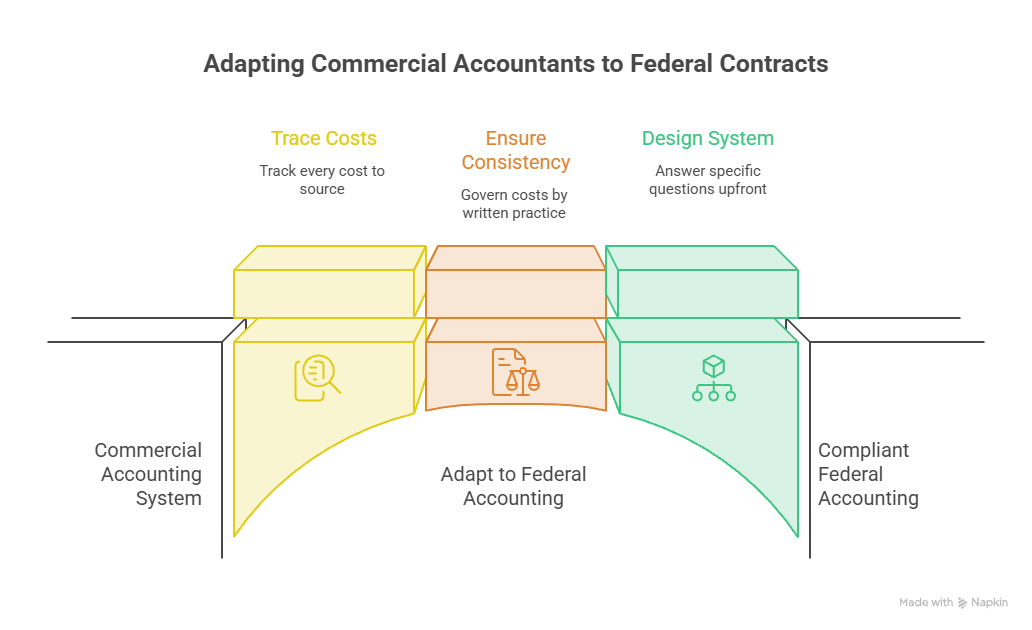
1. Federal Accounting Traces What Commercial Accounting Only Summarizes
Commercial accounting is largely a summary discipline, because the goal is accurate financial statements, defensible tax positions, and useful management reporting. Federal contract accounting works differently, because every cost that touches a contract has to be traceable back through timesheets, approvals, allocation logic, and the general ledger. What surprises most commercial accountants is not the volume of documentation but the standard of connection between records, because a cost that can’t be traced cleanly is treated as a cost that can’t be billed.
2. Consistency Matters More Than Judgment
Commercial accounting rewards judgment, because experienced accountants make defensible calls about how to categorize costs based on the situation in front of them. Federal contract accounting treats that same flexibility as risk, because if a similar cost is treated as direct on one contract and indirect on another without a clear underlying reason, the DCAA reads it as an inconsistency worth examining. The transition takes time, because commercial habits about judgment don’t just carry over unchanged into an environment that expects them to be governed by written practice.
3. The System Itself Has to Be Designed for the Questions
The last shift is structural rather than procedural, because commercial systems are usually designed to produce reports, while federal contract accounting requires a system designed to answer specific questions before any transaction runs through it. Those questions include whether direct and indirect costs are segregated, whether costs can be accumulated by contract, and whether unallowable costs are excluded at the point of entry rather than year-end. Accountants who try to bolt those capabilities onto a commercial system after the first contract award tend to find the retrofit far harder than the original design would have been.
What Watching This Transition Has Taught Me
The commercial accountants who adapt fastest aren’t the ones with the most technical knowledge of the FAR or DCAA guidance. They’re the ones who accept early that federal contract accounting is asking their system to do something structurally different, and that clean books, while important, are only the starting point of what compliance actually requires.